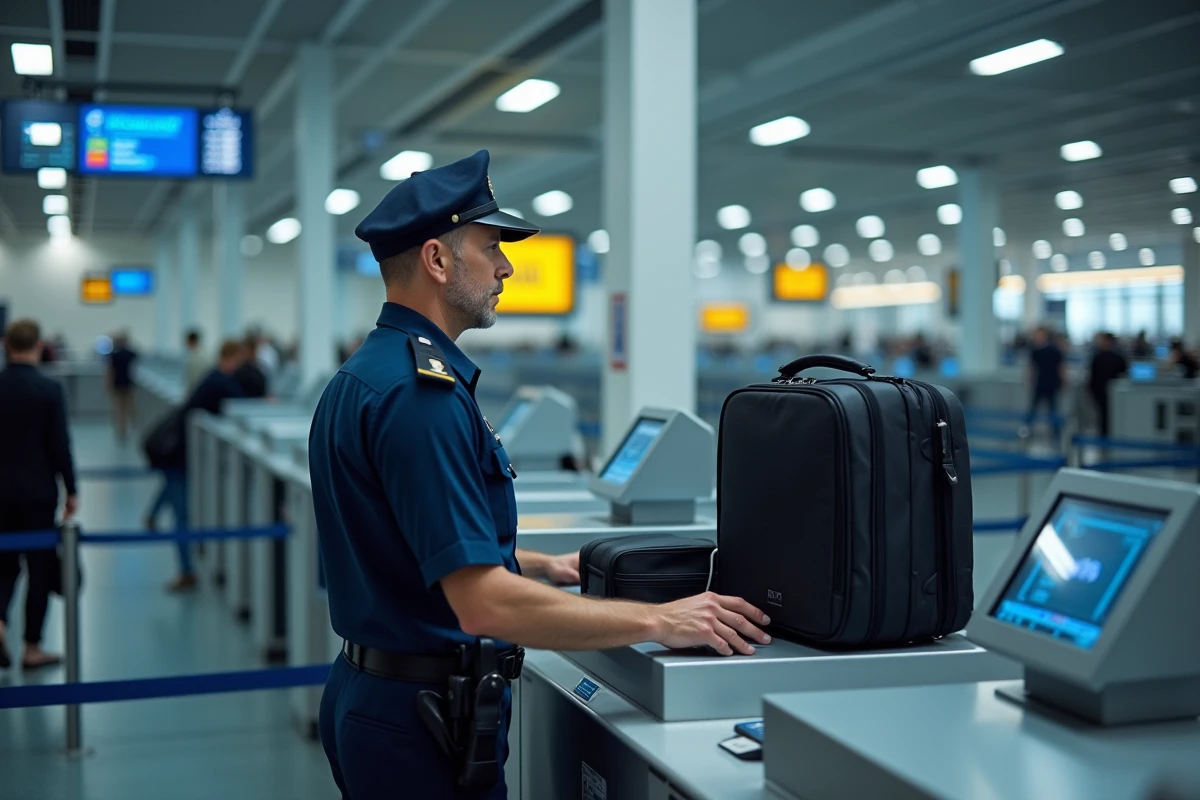
Airport security scanners do not aim to identify banknotes. Their role is to detect any anomalies on the body or in luggage, whether it be a metallic object, a plastic bag, or a bundle of paper. The question of whether banknotes can be detected by a scanner at the airport often arises among travelers carrying cash.
Here is what the technologies used can actually detect, and under what conditions customs intervenes.
Body Scanners and X-rays: What Each Technology Detects Regarding Banknotes
| Technology | Location | Detection of Banknotes | Mechanism |
|---|---|---|---|
| Millimeter Wave Body Scanner | Passenger Gate | Yes (mass close to the body) | Signals any anomaly in shape or density on the body, without identifying the nature of the object |
| X-ray Machine | Luggage Conveyor | Yes (visible bundles) | Produces an image of the objects in the luggage, bundles appear as a dense rectangular block |
| Metal Detector Gate | Passenger Gate | No | Only reacts to metallic masses, paper money does not trigger any alerts |
The millimeter wave body scanner, the one where you stand with your arms raised, is the most likely to signal banknotes carried on a person. It does not read the contents: it detects any unusual mass pressed against the body. A bundle slipped into a belly belt, under clothing, or taped to the torso appears as a suspicious area on the agent’s screen.
To delve deeper into the question of detecting banknotes with a scanner at the airport, several traveler reports confirm that agents then proceed to a targeted pat-down of the indicated area.
The X-ray machine, on the other hand, processes cabin and checked luggage. A thick bundle appears as an opaque rectangular block. The agent may request the opening of the luggage to check the nature of the object. However, a few folded banknotes in a wallet generally do not trigger any particular alert.

Cash Declaration Thresholds by Geographic Area
The physical detection of banknotes is only part of the issue. The main risk concerns non-compliance with mandatory declaration thresholds. These thresholds vary by country and economic area, and ignoring them exposes one to heavy penalties.
- European Union: anyone entering or leaving the EU with an amount equal to or greater than 10,000 euros (or equivalent in other currencies) must declare it to customs. This obligation also applies to transfers via freight or mail.
- United States and Canada: the declaration threshold is set at 10,000 dollars (USD or CAD respectively). The Canada Border Services Agency has made public several cases of travelers intercepted with undeclared amounts, partially or fully confiscated.
- Many countries outside the EU and North America: thresholds vary, sometimes significantly lower. Checking the regulations of the destination country and the transit country remains an essential precaution before departure.
Beyond the threshold, the absence of declaration can lead to partial or total confiscation of cash, accompanied by a fine. Customs authorities do not need the scanner to identify banknotes: a simple targeted check or questioning is sufficient.
Combination of Scanner, Search, and Questioning: The Real Detection Mechanism
Experience reports show that the discovery of significant amounts of cash at the airport rarely results from the scanner alone. It is the combination of scanners, targeted searches, and questioning that leads to the discovery. An agent who spots a bodily anomaly or a suspicious block in a bag will ask questions. If the answers are inconsistent, a thorough inspection follows.
Since 2024, several North American and European authorities have strengthened cross-checks between airport security and customs as part of the fight against money laundering and terrorist financing. Security teams and customs officers share more real-time information, increasing the likelihood that a traveler carrying an undeclared sum will be intercepted.
Cash in Cabin Luggage or on One’s Person: What Difference for Agents
Placing money in cabin luggage means it passes through the X-ray machine. A regular wallet poses no issue. A large bundle, however, draws attention on the screen.
Carrying cash on oneself means the amount passes through the body scanner. As mentioned above, any mass pressed against the body is signaled. Keeping banknotes in a pants pocket remains the least suspicious choice, provided the volume remains reasonable.

Practical Tips for Traveling with Cash Legally
Transporting cash by plane is not prohibited. The key lies in transparency and compliance with declaration obligations.
- Check the declaration threshold of the departure, transit, and arrival countries before traveling. Do not assume that the threshold is universal.
- Fill out the declaration form as soon as the amount reaches or exceeds the threshold. This form is available online or at the customs counter at the airport.
- Keep proof of the source of the funds (bank statement, sales contract, certificate) to answer any questions from customs officers.
- Distribute the banknotes between a wallet in your pocket and cabin luggage rather than creating a single bulky bundle that triggers an anomaly on the scanner.
A traveler declaring their cash risks neither confiscation nor fines, even with a large amount. The declaration protects, it does not expose. Penalties only target concealed or undeclared amounts.
Airport scanners were not designed to read banknotes, but their ability to detect unusual masses, combined with the work of customs, makes concealing large sums very risky. Traveling with cash remains perfectly legal as long as declaration thresholds are respected and the source of funds can be justified.